Thursday, June 18, 2020

Home Equity

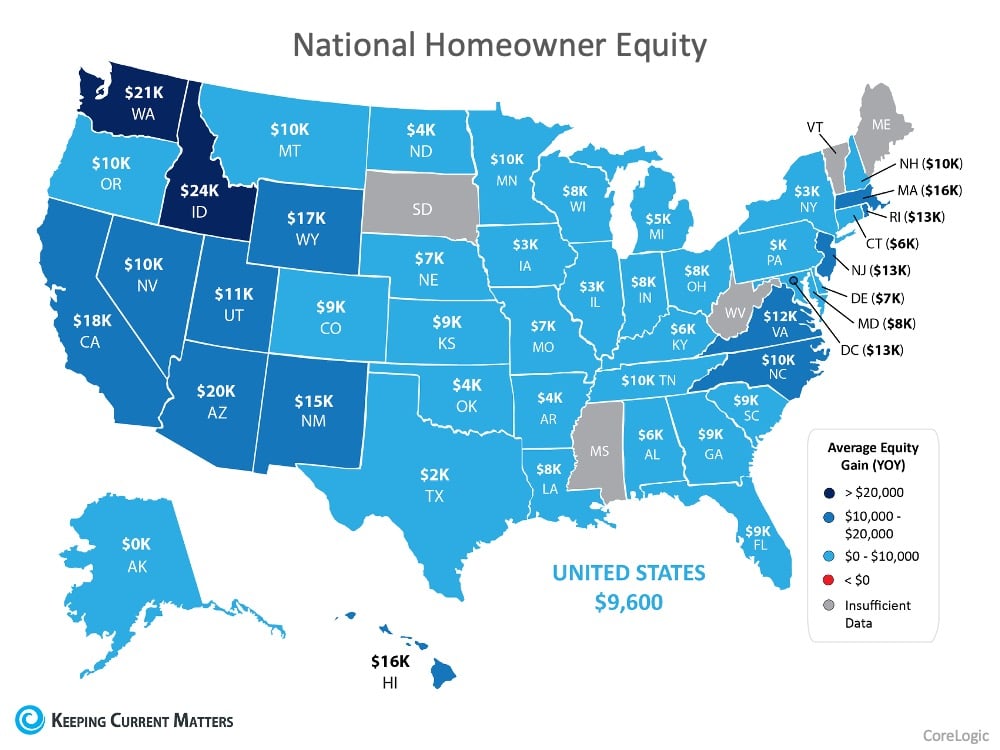
One of the bright spots of the 2020 real estate market is the growth in equity homeowners are experiencing across the country. According to the recently released Homeowner Equity Insights Report from CoreLogic, in nearly every state there was a year-over-year first-quarter equity increase, averaging out to a 6.5% overall gain.

The report notes:

“CoreLogic analysis shows U.S. homeowners with mortgages (roughly 63% of all properties) have seen their equity increase by a total of nearly $590 billion since the first quarter of 2019, an increase of 6.5%, year over year.” (See map below):

Want to Make a Move? Homeowner Equity is Growing Year-Over-Year | Keeping Current MattersThis means that In the first quarter of 2020, the average homeowner gained approximately $9,600 in equity during the past year.”

That’s a huge win for homeowners, especially for those looking to sell their houses and make a move this summer. Having equity to re-invest in your next home is a major force that can make moving a reality, especially while buyers are expressing such a high demand for homes to purchase.

Frank Martell, President and CEO of CoreLogic addresses the potential long-term outlook and how homeowners will likely fare much more positively through the current recession than many did during the last one:

“Many homeowners will experience a recession during their lifetime, and it is reasonable to compare the current recession to those in the past. But the comparison is not apples to apples — every recession is different. Primary drivers of the Great Recession were an overbuilt housing stock, risky mortgages and the collapse of home prices, creating a massive increase in negative equity that proved difficult to recover from. Today’s housing environment has low vacancy and delinquency rates and a large home equity cushion.”

Bottom Line

Now is a great time to consider leveraging your equity and making a move, especially while buyer interest is high. Contact me to explore your equity position and make your next move a reality.

Wednesday, June 17, 2020

Recession? Yes. Real Estate Market Crash? No

On Monday, the National Bureau of Economic Research (NBER) announced that the U.S. economy is officially in a recession. This did not come as a surprise to many, as the Bureau defines a recession this way:
“A recession is a significant decline in economic activity spread across the economy, normally visible in production, employment, and other indicators. A recession begins when the economy reaches a peak of economic activity and ends when the economy reaches its trough. Between trough and peak, the economy is in an expansion.”
Everyone realizes that the pandemic shut down the country earlier this year, causing a “significant decline in economic activity.”
Though not surprising, headlines announcing the country is in a recession will cause consumers to remember the devastating impact the last recession had on the housing market just over a decade ago.
The real estate market, however, is in a totally different position than it was then. As Mark Fleming, Chief Economist at First Americanexplained:
“Many still bear scars from the Great Recession and may expect the housing market to follow a similar trajectory in response to the coronavirus outbreak. But, there are distinct differences that indicate the housing market may follow a much different path. While housing led the recession in 2008-2009, this time it may be poised to bring us out of it.”
Four major differences in today’s real estate market are:
  1. Families have large sums of equity in their homes
  2. We have a shortage of housing inventory, not an overabundance
  3. Irresponsible lending no longer exists
  4. Home price appreciation is not out of control
We must also realize that a recession does not mean a housing crash will follow.  In three of the four previous recessions prior to 2008, home values increased. In the other one, home prices depreciated by only 1.9%.

Bottom Line

Yes, we are now officially in a recession. However, unlike 2008, this time the housing industry is in much better shape to weather the storm.

Monday, June 3, 2019

Starting The Search For Your Dream Home? Here Are 5 Tips!


In today’s real estate market, low inventory dominates the conversation in many areas of the country. It can often be frustrating to be a first-time homebuyer if you aren’t prepared.
In a realtor.com article entitled, “How to Find Your Dream Home—Without Losing Your Mind,” the author highlights some steps that first-time homebuyers can take to help carry their excitement of buying a home throughout the whole process.

1. Get Pre-Approved for a Mortgage Before You Start Your Search

One way to show you are serious about buying your dream home is to get pre-qualified or pre-approved for a mortgage before starting your search. Even if you are in a market that is not as competitive, understanding your budget will give you the confidence of knowing whether or not your dream home is within your reach.
This step will also help you narrow your search based on your budget and won’t leave you disappointed if the home you tour, and love, ends up being outside your budget!

2. Know the Difference Between Your ‘Must-Haves’ and ‘Would-Like-To-Haves’

Do you really need that farmhouse sink in the kitchen to be happy with your home choice? Would a two-car garage be a convenience or a necessity? Could the ‘man cave’ of your dreams be a future renovation project instead of a make-or-break right now?
Before you start your search, list all the features of a home you would like and then qualify them as ‘must-haves’‘should-haves’, or ‘absolute-wish list’ items. This will help keep you focused on what’s most important.

3. Research and Choose a Neighborhood You Want to Live In

Every neighborhood has its own charm. Before you commit to a home based solely on the house itself, the article suggests test-driving the area. Make sure that the area meets your needs for “amenities, commute, school district, etc. and then spend a weekend exploring before you commit.”

4. Pick a House Style You Love and Stick to It

Evaluate your family’s needs and settle on a style of home that would best serve those needs. Just because you’ve narrowed your search to a zip code, doesn’t mean that you need to tour every listing in that zip code.
An example from the article says, “if you have several younger kids and don’t want your bedroom on a different level, steer clear of Cape Cod–style homes, which typically feature two or more bedrooms on the upper level and the master on the main.”

5. Document Your Home Visits

Once you start touring homes, the features of each individual home will start to blur together. The article suggests keeping your camera handy to document what you love and don’t love about each property you visit.
Making notes on the listing sheet as you tour the property will also help you remember what the photos mean, or what you were feeling while touring the home.

Bottom Line

In a high-paced, competitive environment, any advantage you can give yourself will help you on your path to buying your dream home.


Story taken from "Keeping Current Matters".

Saturday, June 1, 2019

What Is Really Happening With Home Prices?


Home values have softened over the last twelve months. We are no longer seeing 6-7% annual appreciation levels for the national housing market. The current numbers are closer to 4%. Some have suggested that year-over-year appreciation levels could fall to 3% or less this year.
However, a stronger-than-expected economy and a good spring housing market have changed some opinions. Some analysts are now predicting that home value appreciation may begin to increase as we move forward.

Here are three examples:

Mark Fleming, Chief Economist of First American

“Data on the movement of unadjusted house prices during the early spring home-buying season won’t be available for a few more months, but it’s quite likely that price appreciation will accelerate again.”

CoreLogic’s April “Home Price Insights

“Home prices nationwide, including distressed sales, increased year over year by 3.7% in March 2019 compared with March 2018…The CoreLogic HPI Forecast indicates that home prices will increase by 4.8% on a year-over-year basis from March 2019 to March 2020.”

Pulsenomics’ Quarterly “Home Price Expectation Survey”

  • The 2018 4th Quarter survey called for 3.8% appreciation for 2019.
  • The 2019 1st Quarter survey raised the appreciation projection for this year to 4.3%.

Bottom Line

Price appreciation has slowed over the past year. However, a strong economy and a good housing market have many experts thinking that home values might re-accelerate moderately throughout the rest of this year.


Story taken from "Keeping Current Matters".

Thursday, May 30, 2019

New Research Shows Housing Is Affordable For First-Time Buyers


Home prices have been on the rise for the last seven years, leading many housing market analysts to conclude that first-time homebuyers are being shut out of the market due to affordability concerns.
The National Association of Realtors (NAR) reports on the percentage of First-Time Home Buyers (FTHB) on a monthly and yearly basis. Their latest report shows that FTHB’s made up 33% of buyers in March, which matches their reported share in 2018.
NAR uses survey data from their members to come up with this statistic, so their results do not include every transaction completed. Rather, they only show the transactions reported by members who complete the survey.
The other entity that reports on FTHB share is the American Enterprise Institute (AEI). The AEI uses data from mortgage applications that define an FTHB as “any borrower who did not have a mortgage for the preceding three years.”
This means the AEI measurement also includes former homeowners who transitioned out of a home they previously owned and re-entered the market after at least 3 years. The latest FTHB share data from AEI shows that first-time buyers made up 57.5% of all mortgages in August 2018. NAR’s data shows a 31% share for the same time period.
New research from the New York Federal Reserve shows that these traditional reports on FTHB share have been unable to give an accurate depiction of this group’s involvement in the market.
The NY Fed was able to take consumer credit data and identify when a mortgage payment entered a consumer’s credit report to determine when a first-time home purchase was made. Using this data, they were able to show that AEI’s reported FTHB share was consistently 10% higher. The NAR reports were right on par with their findings until 2010, when NAR’s share dropped to the 11% gap seen today.

So, what does this all mean?

First-time home buyers have not disappeared from the market as many analysts had believed. Buying a home is very much a part of the American Dream for younger generations, just like it had been for their parents and grandparents.
This also means that rising prices have not scared buyers away from the market. Many first-time buyers are making sacrifices to save their down payment and make their dream a reality.

Bottom Line

If you are one of the many renters who is scrolling through listings on your phone every night dreaming of buying your own home, there are opportunities in every market to make that dream a reality!


Story taken from "Keeping Current Matters".

Tuesday, May 28, 2019

The Cost Of Renting Vs. Buying This Spring [INFOGRAPHIC]


Some Highlights:

  • Historically, the choice between renting or buying a home has been a tough decision.
  • Looking at the percentage of income needed to rent a median-priced home today (27.7%) vs. the percentage needed to buy a median-priced home (17.5%), the choice becomes obvious.
  • Every market is different. Before you renew your lease again, find out if you can put your housing costs to work by buying this year!


Story taken from "Keeping Current Matters".

Saturday, May 25, 2019

NEW CONSTRUCTION HOME SALES AND MEDIAN HOME PRICES CONTINUE TO CLIMB IN ADA COUNTY

Key Takeaways:
  •  New construction sales are gaining more and more of the market share and continuing to influence the overall median sales price.
  • In the existing home segment, the median sales price has been rising due to a persistent lack of supply, especially in the lower price points.
  • An increased share of higher-priced existing homes has contributed to the higher median sales price reported for the existing home segment.
New Construction’s Impact on the Overall MarketAs reported last month, new construction sales are gaining more and more of the total market share in Ada County. Since new homes generally sell for more than existing homes, new home sales continue to have a greater impact on the overall median sales price. In February 2019, new construction sales made up 38.7% of all home sales in Ada County. In March 2019, that share increased to 39.8% resulting in an overall median sales price of $335,000, an increase of 8.4% year-over-year and a record high for Ada County.
Existing Home Prices Up Due to Lack of Lower-Priced InventoryIn the existing home segment, the median sales price has been rising due to a persistent lack of supply, especially in the lower price points. This pushed the median sales price for existing homes in Ada County to $309,900 in March 2019, an increase of 6.9% year-over-year and a record high for the county.
While we have seen gains in the number of existing homes for sale over the past few months, the additional inventory and resulting sales have primarily been in the upper-end of the market:
As with new construction’s impact on the overall market, the increased share of higher-priced existing homes has contributed to the higher median sales price reported for the existing home segment.
Where do Condo and Townhomes Fit In?Traditionally BRR has not reported on the condo/townhome segment, due to the very small market share it represents (less than 10% of the sales and inventory). However, the smaller footprint and shared land costs provide an average list price that’s about 8-9% less than that of single-family homes. While there are not as many condos or townhomes to look at, and there may be costs beyond the purchase price, such as homeowners’ association fees, these could be an option for some buyers.
We’re seeing some shifting dynamics in our local market with the increase in new construction sales and higher-priced existing home sales. However, this doesn’t mean that there still are not affordable options for those who are looking. Now is the time to talk to your REALTOR® about your options.

HOME SALES AND PRICES CONTINUE TO RISE IN ELMORE COUNTY
The median sales price for homes in Elmore County reached $167,500 in March 2019, an increase of 13.9% compared to the same time last year. Due to the smaller number of transactions that occur in the area, we use a rolling 12-month median sales price, to get a better idea of the overall trends.
This price increase was due in part to more homes being sold at overall higher price points. In March, there were 45 closed sales in Elmore County, up 15.4% from March 2018.
Additionally, buyer demand has continued to outpace supply, putting even more pressure on home prices. In March 2019, the Months Supply of Inventory in Elmore County was at just 0.8 months —  down 60.0% from the same month last year.
The Months Supply of Inventory metric (or MSI) measures the relationship between pending sales (which measures buyer demand) and inventory (which measures supply). A balanced market—not favoring buyers or sellers—is typically when MSI is between 4-6 months of supply. MSI below four months is usually more favorable to sellers, while MSI above six months is usually more favorable to buyers.
We will continue to monitor how the new construction segment impacts the median sales price, but for those looking to buy or sell, talking to a REALTOR® is the best way to get information about market trends specific to your situation.

HOME SALES AND PRICES UP IN GEM COUNTY
In March 2019, 24 homes sold in Gem County, up 33.0% from March 2018. This left 39 new and existing/resale homes available for sale at the end of the month, down 4.9% from a year ago.
Pending sales (or homes under contract) measures buyer demand, while inventory (or homes for sale) measures supply. The relationship between these two metrics is reported as Months Supply of Inventory (or MSI), which was at 1.9 months in March 2019.
A balanced market—not favoring buyers or sellers—is typically when MSI is between 4-6 months of supply. MSI below four months is usually more favorable to sellers, while MSI above six months is usually more favorable to buyers.
Gem County has had persistently low existing/resale inventory for the last several years, resulting in buyer demand outpacing supply, as shown through the low MSI calculation. This, in turn, has caused home prices to rise in Gem County.
Based on the rolling median data between March 2018 and March 2019, the median sales price for Gem County was $204,250, an increase of 6.2% over the same period last year. We use a rolling 12-month median sales price, to get a better idea of the overall trends due to the smaller number of transactions that occur in the area.
As buyer demand continues to grow, so too will the price of homes in Gem County. If you are considering a move—whether buying or selling— contact us and we can help you determine what’s right for you


Story taken from "Boise Regional Realtors".