Friday, January 25, 2019

Where Are Mortgage Interest Rates Headed In 2019?


The interest rate you pay on your home mortgage has a direct impact on your monthly payment; the higher the rate, the greater the payment will be. That is why it is important to know where rates are headed when deciding to start your home search.
Below is a chart created using Freddie Mac’s U.S. Economic & Housing Marketing Outlook. As you can see, interest rates are projected to increase steadily over the course of the next year.


How Will This Impact Your Mortgage Payment?

Depending on the amount of the loan that you secure, a half of a percent (.5%) increase in interest rate can increase your monthly mortgage payment significantly.
According to CoreLogic’s latest Home Price Index, national home prices have appreciated 6.2% from September 2018 and are predicted to be 5.1% higher this year.
If both the predictions of home price and interest rate increases become a reality, families would wind up paying considerably more for their next homes.

Bottom Line

Even a small increase in interest rate can impact your family’s wealth, so don’t wait until next year! Meet with us an we can evaluate your ability to purchase your dream home now.


Story taken from "Keeping Current Matters".

Wednesday, January 23, 2019

3 Key Components Of A Home Appraisal


What are the 3 key components of a home appraisal?

 
A home appraisal consists of these three components:
1. A Physical Examination of the Property:
The physical inspection at the house may take an appraiser as little as 30 minutes to perform or could take as long as two to three hours. This depends on the size of the house, known as Gross Living Area (GLA) and also the design of the home. An artsy Contemporary style home takes longer to measure than a standard rectangular Colonial home. Physical visits are usually brief when a home is in average to very good condition. 


2. Selecting Comparables:
Next, finding the most recent/similar sales that are located approximately within a mile of the property, and that have closed within the past 6 months, are what every appraiser is seeking! These properties are used to establish an accurate opinion of value. The appraiser will locate the most appropriate and comparable sales to be included in his appraisal report.


3. Completing The Appraisal Report:
After a thorough physical examination of the property and  locating the best comparable sales available, the appraiser will start entering all of this data into a standard appraisal report form. Once all of the data is entered, the appraiser evaluates all of this information so he can arrive at his final estimate of market value. Fortunately, almost all residential properties require only short form reports, usually 10 pages or less. Appraisers often can complete a report in about 5 hours. Depending on the appraiser's workload and on the complexity of the property, an appraisal report should be completed and delivered to the lender in about a week.  Rush appraisals are done quicker when requested.


Info taken from "Norman, Hubbard and Associates".

Monday, January 21, 2019

Home Sales Expected To Continue Increasing In 2019


Freddie MacFannie Mae, and the Mortgage Bankers Association are all projecting that home sales will increase nicely in 2019. Below is a chart depicting the projections of each entity for the end of 2018, as well as for 2019.


As we can see, Freddie MacFannie Mae, and the Mortgage Bankers Association all believe that homes sales will increase steadily over the next year. If you are a homeowner who has considered selling your house recently, now may be the best time to put it on the market.


Story taken from "Keeping Current Matters".

Saturday, January 19, 2019

5 Real Estate Reality TV Myths Explained


Have you ever been flipping through the channels, only to find yourself glued to the couch in an HGTV binge session? We’ve all been there, watching entire seasons of “Love it or List it,” “Million Dollar Listing,” “House Hunters,” “Property Brothers,” and so many more all in one sitting.
When you’re in the middle of your real estate themed show marathon, you might start to think that everything you see on TV must be how it works in real life, but you may need a reality check.

Reality TV Show Myths vs. Real Life:

Myth #1: Buyers look at 3 homes and decide to purchase one of them.Truth: There may be buyers who fall in love and buy the first home they see, but according to the National Association of Realtors the average homebuyer tours 10 homes as a part of their search.  
Myth #2: The houses the buyers are touring are still for sale.Truth: Everything is staged for TV. Many of the homes being shown are already sold and are off the market. 
Myth #3: The buyers haven’t made a purchase decision yet.Truth: Since there is no way to show the entire buying process in a 30-minute show, TV producers often choose buyers who are further along in the process and have already chosen a home to buy. 
Myth #4: If you list your home for sale, it will ALWAYS sell at the open house.Truth: Of course, this would be great! Open houses are important to guarantee the most exposure to buyers in your area but are only a PIECE of the overall marketing of your home. Keep in mind that many homes are sold during regular showing appointments as well. 
Myth #5: Homeowners decide to sell their homes after a 5-minute conversation.Truth: Similar to the buyers portrayed on the shows, many of the sellers have already spent hours deliberating the decision to list their homes and move on with their lives/goals.

Bottom Line

Having an experienced professional on your side while navigating the real estate market is the best way to guarantee that you can make the home of your dreams a reality! Give us a call and we will be happy to help you out!


Story taken from "Keeping Current Matters".

Thursday, January 17, 2019

The Net Worth Of A Homeowner Is 44x Greater Than A Renter!


Every three years, the Federal Reserve conducts their Survey of Consumer Finances in which they collect data across all economic and social groups. Their latest survey data, covering 2013-2016 was recently released.
The study revealed that the median net worth of a homeowner was $231,400 – a 15% increase since 2013. At the same time, the median net worth of renters decreased by 5% ($5,200 today compared to $5,500 in 2013).
These numbers reveal that the net worth of a homeowner is over 44 times greater than that of a renter.

Owning a home is a great way to build family wealth

As we’ve said before, simply put, homeownership is a form of ‘forced savings.’ Every time you pay your mortgage, you are contributing to your net worth by increasing the equity in your home.
That is why, for the fifth year in a row, Gallup reported that Americans picked real estate as the best long-term investment. This year’s results showed that 34% of Americans chose real estate, followed by stocks at 26% and then gold, savings accounts/CDs, or bonds.

Greater equity in your home gives you options

If you want to find out how you can use the increased equity in your house to move to a home that better fits your current lifestyle, call us and we can guide you through the process.


Story taken from "Keeping Current Matters".

Saturday, January 12, 2019

What If I Wait A Year To Buy A Home?


National home prices have increased by 5.4% since this time last year. Over that same time period, interest rates have remained near historic lows which has allowed many buyers to enter the market and lock in low rates.
As a seller, you will likely be most concerned about ‘short-term price’ – where home values are headed over the next six months. As a buyer, however, you must not be concerned about price but instead about the ‘long-term cost’ of the home.
The Mortgage Bankers Association (MBA), Freddie Mac, and Fannie Mae all project that mortgage interest rates will increase by this time next year. According to CoreLogic’s most recent Home Price Insights Reporthome prices will appreciate by 4.8% over the next 12 months.

What Does This Mean as a Buyer?

If home prices appreciate by 4.8% over the next twelve months as predicted by CoreLogic, here is a simple demonstration of the impact that an increase in interest rate would have on the mortgage payment of a home selling for approximately $250,000 today:

Bottom Line

If buying a home is in your plan for this year, doing it sooner rather than later could save you thousands of dollars over the terms of your loan.


Story taken from "Keeping Current Matters".

Thursday, January 10, 2019

Excited About Buying A Home This Year? Here’s What To Watch


As we kick off the new year, many families have made resolutions to enter the housing market in 2019. Whether you are thinking of finally ditching your landlord and buying your first home or selling your starter house to move into your forever home, there are two pieces of the real estate puzzle you need to watch carefully: interest rates & inventory.

Interest Rates

Mortgage interest rates had been on the rise for much of 2018, but they made a welcome reversal at the end of the year. According to Freddie Mac’s latest Primary Mortgage Market Survey, rates climbed to 4.94% in November before falling to 4.62% for a 30-year fixed rate mortgage last week. Despite the recent drop, interest rates are projected to reach 5% in 2019.
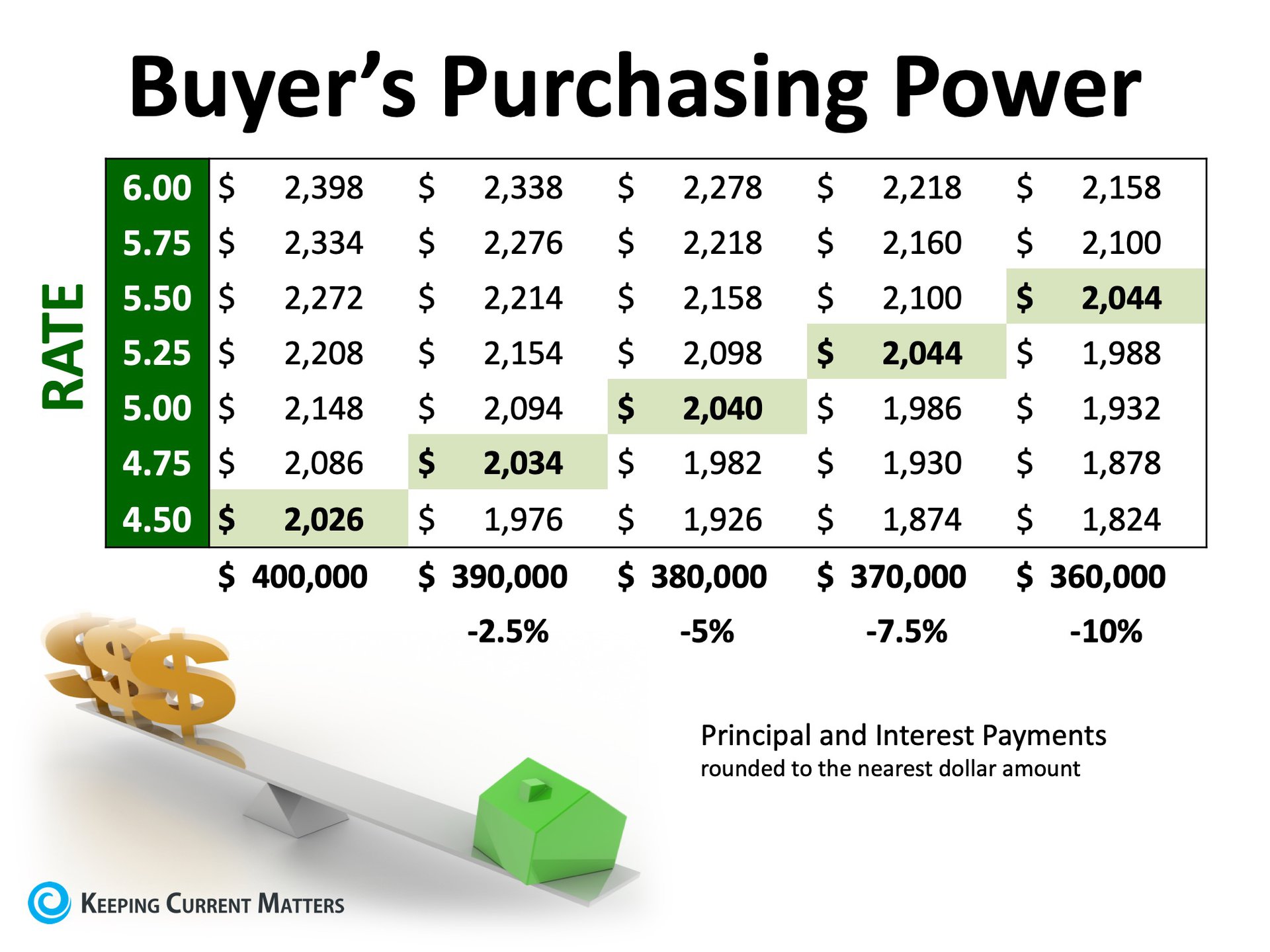
The interest rate you secure when buying a home not only greatly impacts your monthly housing costs, but also impacts your purchasing power.
Purchasing power, simply put, is the amount of home you can afford to buy for the budget you have available to spend. As rates increase, the price of the house you can afford to buy will decrease if you plan to stay within a certain monthly housing budget.


The chart below shows the impact that rising interest rates would have if you planned to purchase a $400,000 home while keeping your principal and interest payments between $2,020-$2,050 a month.
With each quarter of a percent increase in interest rate, the value of the home you can afford decreases by 2.5% (in this example, $10,000).

Inventory

A ‘normal’ real estate market requires there to be a 6-month supply of homes for sale in order for prices to increase only with inflation. According to the National Association of Realtors (NAR), listing inventory is currently at a 3.9-month supply (still well below the 6-months needed), which has put upward pressure on home prices. Home prices have increased year-over-year for the last 81 straight months.
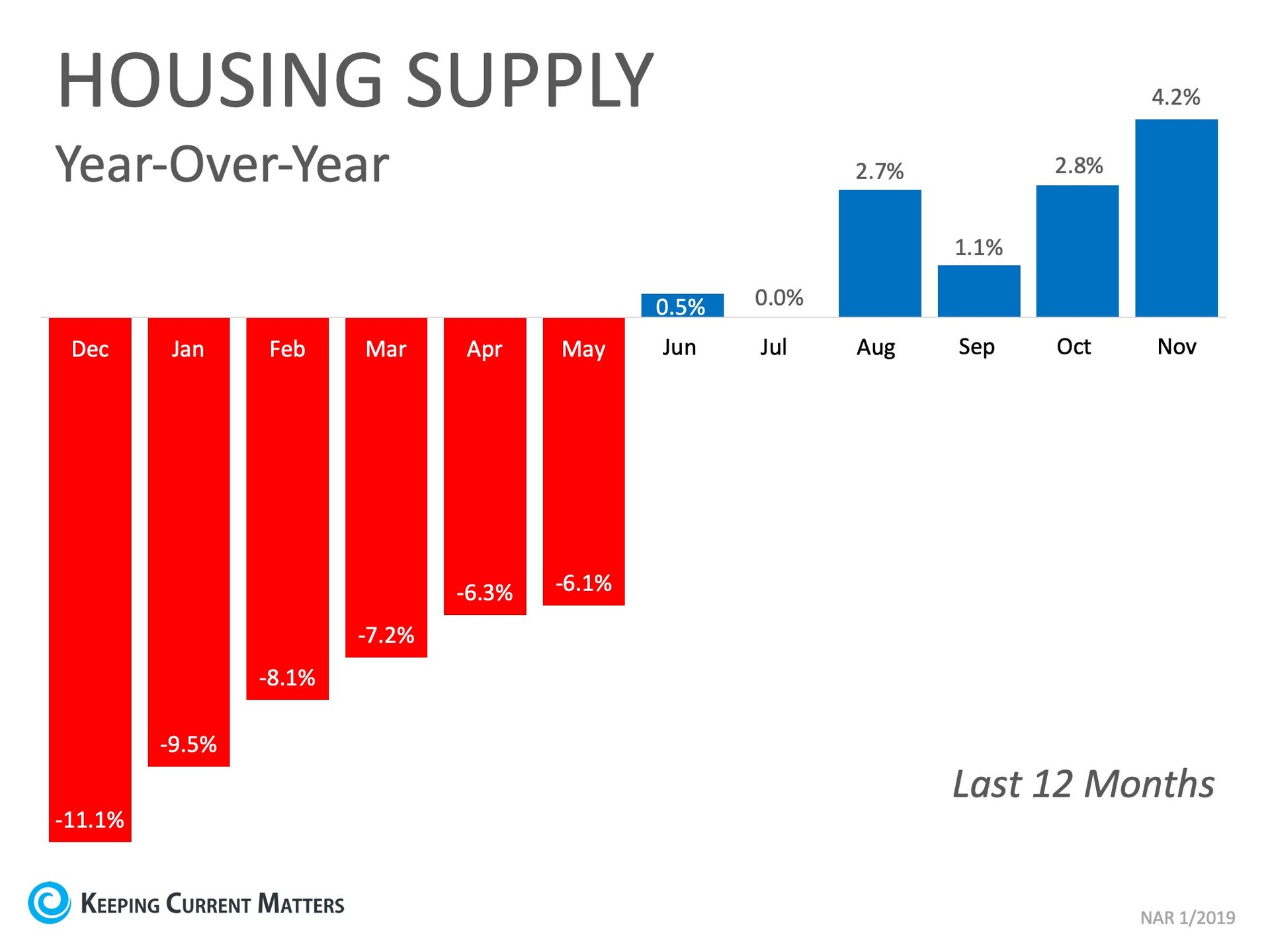
The inventory of homes for sale in the real estate market had been on a steady decline and experienced year-over-year drops for 36 straight months (from July 2015 to May 2018), but we are starting to see a shift in inventory over the last six months.

The chart below shows the change in housing supply over the last 12 months compared to the previous 12 months. As you can see, since June, inventory levels have started to increase as compared to the same time last year.
This is a trend to watch as we move further into the new year. If we continue to see an increase in homes for sale, we could start moving further away from a seller’s market and closer to a normal market.

Bottom Line

If you are planning to enter the housing market, either as a buyer or a seller, make sure that you have an experienced local agent who can help you navigate the changes in mortgage interest rates and inventory.


Story taken from "Keeping Current Matters".