

Monday, October 20, 2014
Friday, October 17, 2014
New Construction = New Competition
 For the last several years, home sellers had to compete with huge inventories of distressed properties (foreclosures and short sales). The great news is that the supply of these properties is falling like a rock in the vast majority of housing markets (only 8% of homes sold in August). Many homeowners are now thinking of selling as the impact of this substantially discounted competition has disappeared. However, every seller of an existing residential property must realize that there is a new form of competition hitting the market: newly constructed homes. According to the National Association of Home Builders (NAHB),new-home sales topped 500,000, in August, for the first time since 2008.
“This jump in sales activity is in line with our latest surveys, which indicate builders are seeing increased traffic and more serious buyers in the market for single-family homes,” said Kevin Kelly, chairman of the NAHB.
Broken down regionally, new home sales rose:
- 50% in the West
- 29.2% in the Northeast
- 7.8% in the South
- and were unchanged in the Midwest
Bottom Line
If you are thinking of selling, perhaps you should do it now to avoid additional competition coming to the market.
Thursday, October 16, 2014
A Home’s Cost vs. Price Explained
 We have often talked about the difference between COST and PRICE. As a seller, you will be most concerned about ‘short term price’ – where home values are headed over the next six months. As either a first time or repeat buyer, you must not be concerned about price but instead about the ‘long term cost’ of the home.
Let us explain.
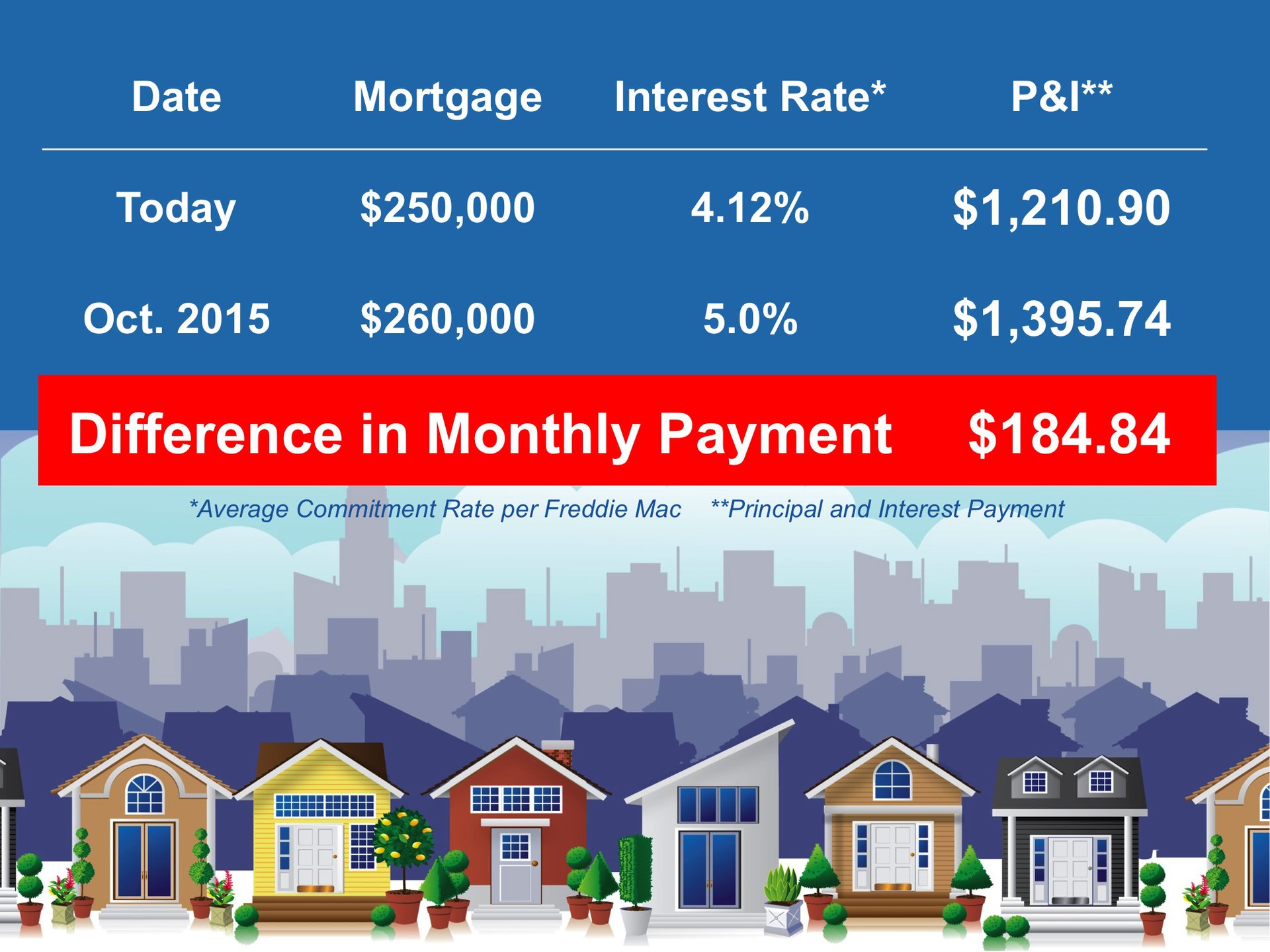
Recently, we reported that a nationwide panel of over one hundred economists, real estate experts and investment & market strategists projected that home values would appreciate by approximately 4% from now to the end of 2015. Additionally, Freddie Mac’s most recent Economic Commentary & Projections Table predicts that the 30 year fixed mortgage rate will be 5.0% by the end of next year.
What Does This Mean to a Buyer?
Here is a simple demonstration of what impact these projected changes would have on the mortgage payment of a home selling for approximately $250,000 today:
Wednesday, October 15, 2014
September Market Report – Sales Start to Cool
by Marc Lebowitz, RCE, CAE
Executive Director
Ada County Association of REALTORS
Single family home sales in September 2014 were 651 in Ada County, a decrease of 6% compared to September 2013. YTD total sales are down 5% compared to this time last year; 5,920 homes sold compared to 6,203.
In September, sales of homes priced above $200,000 showed increases in nearly every price category. Overall sales are continue to lag because sales of homes in the five categories priced below $159,999 are down anywhere from 1% ($160,000 to $199,999) to 200% (70,000 to $89,999). The biggest trend “reversal” was in the $120,000 - $159,000 range. This category had been increasing steadily until September when it fell 15%.
Average Days on Market in September were 54; one more day than last month. In September 2013, Days on Market was 45.
New homes sold in September totaled 120; down 10% from last year; up 4% from August.
Existing home sales were 531; down 6% from September 2013.
Historically September sales decrease from August levels by an average of 10%. Last year the increase was 16%. This year there was a decrease of 12%.
Pending sales at the end of September were 930; down just 3% from September 2013. This is the smallest “decrease” in Pending sales all year (April was down 18%). This bodes well for a 4th quarter sales “rebound”.
September median home price was $205,551; up 4% from September 2013. Our YTD median price is $209,900; up 8% over last year.
New Homes median price for September was $283,5530; up 7% from September 2013. For Existing homes the increase is 3% to $191,000.
The number of houses available for sale at the end of September decreased 4% from August 2014 to 2,857. This is 11% more than last year at this time.
As is typical this time of year, inventory contracted in all price categories for September; with the exception of homes priced between $400,000 and $500,000 which grew modestly.
In Ada County we now have 3.9 months of inventory on hand, essentially unchanged from the end of July.
The price categories in shortest supply are $100,000 to $119,000 which has 1.7 months; and $120,000 – $159,000 which has 2.3 months.
From $200,000 to $400,000 we have 4 months available.
Of sales in September, the two price points that held on to their summer pace were $120,000 – $160,000 and $160,000 to $200,000.
So…what’s next?
Our late Summer sales tried hard, but couldn't make up for the surge in July and August 2013. We have narrowed the gap, but not surpassed 2013…yet. There was a slow down during the last three months of 2013. Our expectation continues to be a strong fourth quarter.
We have more inventory coming online in the <$160,000 which will release some pent up demand among first time buyers.
Executive Director
Ada County Association of REALTORS
Single family home sales in September 2014 were 651 in Ada County, a decrease of 6% compared to September 2013. YTD total sales are down 5% compared to this time last year; 5,920 homes sold compared to 6,203.
In September, sales of homes priced above $200,000 showed increases in nearly every price category. Overall sales are continue to lag because sales of homes in the five categories priced below $159,999 are down anywhere from 1% ($160,000 to $199,999) to 200% (70,000 to $89,999). The biggest trend “reversal” was in the $120,000 - $159,000 range. This category had been increasing steadily until September when it fell 15%.
Average Days on Market in September were 54; one more day than last month. In September 2013, Days on Market was 45.
New homes sold in September totaled 120; down 10% from last year; up 4% from August.
Existing home sales were 531; down 6% from September 2013.
Historically September sales decrease from August levels by an average of 10%. Last year the increase was 16%. This year there was a decrease of 12%.
Pending sales at the end of September were 930; down just 3% from September 2013. This is the smallest “decrease” in Pending sales all year (April was down 18%). This bodes well for a 4th quarter sales “rebound”.
September median home price was $205,551; up 4% from September 2013. Our YTD median price is $209,900; up 8% over last year.
New Homes median price for September was $283,5530; up 7% from September 2013. For Existing homes the increase is 3% to $191,000.
The number of houses available for sale at the end of September decreased 4% from August 2014 to 2,857. This is 11% more than last year at this time.
As is typical this time of year, inventory contracted in all price categories for September; with the exception of homes priced between $400,000 and $500,000 which grew modestly.
In Ada County we now have 3.9 months of inventory on hand, essentially unchanged from the end of July.
The price categories in shortest supply are $100,000 to $119,000 which has 1.7 months; and $120,000 – $159,000 which has 2.3 months.
From $200,000 to $400,000 we have 4 months available.
Of sales in September, the two price points that held on to their summer pace were $120,000 – $160,000 and $160,000 to $200,000.
So…what’s next?
Our late Summer sales tried hard, but couldn't make up for the surge in July and August 2013. We have narrowed the gap, but not surpassed 2013…yet. There was a slow down during the last three months of 2013. Our expectation continues to be a strong fourth quarter.
We have more inventory coming online in the <$160,000 which will release some pent up demand among first time buyers.
Thursday, October 9, 2014
Should I Rent My Home?
 A recent study has concluded that 39% of buyers prefer to rent out their last residence rather than sell it when purchasing their next home.
The study cites that many homeowners were able to refinance and “locked in a very low mortgage rate in recent years. That low rate, combined with a strong rental market, means they can charge more in rent than they pay in mortgage each month... so they are going for it.”
This logic makes sense in some cases. Residential real estate is a great investment right now. However, if you have no desire to actually become an educated investor in this sector, you may be headed for more trouble than you were looking for. Are you ready to be a landlord? Before renting your home, you should answer the following questions to make sure this is the right course of action for you and your family.
10 Questions to ask BEFORE renting your home
- How will you respond if your tenant says they can’t afford to pay the rent this month because of more pressing obligations? (This happens most often during holiday season and back-to-school time when families with children have extra expenses).
- Because of the economy, many homeowners cannot make their mortgage payment. What percentage of tenants do you think cannot afford to pay their rent?
- Have you interviewed experienced eviction attorneys in case a challenge does arise?
- Have you talked to your insurance company about a possible increase in premiums as liability is greater in a non-owner occupied home?
- Will you allow pets? Cats? Dogs? How big a dog?
- How will you actually collect the rent? By mail? In person?
- Repairs are part of being a landlord. Who will take tenant calls when necessary repairs come up?
- Do you have a list of craftspeople readily available to handle these repairs?
- How often will you do a physical inspection of the property?
- Will you alert your current neighbors that you are renting the house?
Bottom Line
Again, renting out residential real estate historically is a great investment. However, it is not without its challenges. Make sure you have decided to rent the house because you want to be an investor, not because you are hoping to get a few extra dollars by postponing a sale.
Wednesday, October 8, 2014
What You Don't Know About Your Credit Score...Could Cost You!
 Today we are excited to have Nabil Captan as our guest blogger. Nabil is a nationally recognized credit scoring expert, educator, author and producer. In today’s post, he explains how what you don’t know about your credit score could end up costing you. Enjoy! – The KCM Crew Informed consumers considering a home purchase today want to do the right thing and plan ahead. Many do not seek immediate professional guidance from a Realtor or a mortgage loan officer. Instead, they hunt for hours online, looking at numerous websites for available homes for sale. They also consult websites to find the best interest rate and terms for future monthly mortgage payments. Many consumers feel betrayed, cheated and at times embarrassed to learn that the credit scores they counted on, to get that specific interest rate for their loan, are not used by mortgage lenders. When shopping for a good mortgage interest rate, consumers also need to know their credit score, and utilize an online mortgage calculator to compute future monthly mortgage payments. A Google search for “credit score” will yield hundreds of results. The consumer accepts the provider’s terms and conditions to get a free credit score. Terrific! Unaware that in exchange they just received a meaningless credit score that lenders never use. They also handed over their Non-Public Personal Information (NPPI) to that credit score provider for life. Before we go any further, let’s look at available credit scoring products available to consumers today:
- FICO credit score from Fair Isaac Corporation/myfico.com, range 300 to 850
- Plus Score from Experian, range 320 to 830
- Trans Risk Score from TransUnion, range 300 to 850
- Equifax Credit Score from Equifax, range 300 to 850
- Vantage Score from all three bureaus, two ranges, 300 to 850 and 501-990
What is a FICO Score?
In 1958, Bill Fair and Earl Isaac, a mathematician and engineer, formed a company in San Rafael, California. They created tools to help risk managers make a better decision when taking financial risk. Today, 90 percent of all lenders use the FICO score, first created in 1989 by Fair Isaac, and it’s the only score Fannie Mae and Freddie Mac, the Federal Housing Agency and Veterans Affairs will accept in underwriting loans they guarantee.
What is a Consumer Score?
The three credit bureaus, in their understanding of the credit scoring model created by FICO, decided to create their own scoring models, and in 2004 – 2006 they unveiled the “consumer” scores: Plus Score, Trans Risk Score, Equifax Credit Score, and Vantage Score. However, these are not genuine FICO scores, and mortgage lenders don’t use them. Consider this comparison: Would you buy a watch that gives the approximate time of day? The three credit bureaus work with major financial institutions, professional organizations, comparison sites, personal finance businesses, clubs such as Costco, AAA, Sam’s Club, and many data-mining brokers to bombard consumers in the race of the free credit score mania, all with the enticement of a “consumer” score that is not used by lenders, in hopes of obtaining subscriptions or fees from consumers. Fees that are totally unnecessary!
Know Your Score
Gaining access to one’s own credit report and credit score prior to loan approval with no strings attached could be helpful, and at all times beneficial. With little effort, inaccuracy of information can be instantly corrected at the credit bureau level, and with a few simple steps, credit scores could be enhanced. For example, paying down revolving account balances before a creditor’s statement-ending date (the creditor later updates account information with the credit bureaus), thus reducing revolving account balances at a particular point in time, will positively add more points to a score. It’s priceless.
More Information
Consumers have a legal right to access their annual credit report at no charge once a year from annualcreditreport.com, a site sponsored by the three major credit bureaus: Experian, Equifax and TransUnion. These reports provide all the basic consumer data, but do not reveal a credit score. If you have a need for the FICO credit score that is actually used by mortgage lenders, myfico.com is the website to visit. For $19.95 per bureau, consumers can purchase a customized credit report with a genuine FICO score. Additional websites to visit: the Federal Trade Commission (ftc.gov) and the Consumer Financial Protection Bureau (cfpb.gov) for true answers to questions about any financial concepts, financial products, dispute and complaint submissions, and much more.
Saturday, October 4, 2014
Future Homeowners Share American Dream
 Two recently released reports indicate that both young adults (Millennials) and teenagers (Generation Z) still see homeownership as an important piece of their future success. A report byThe Demand Institute, Millennials and Their Homes: Still Seeking the American Dream, revealed that the Millennial Generation is optimistic about their financial future and still believe in homeownership. The findings were based on a survey of millennial households (ages 18 to 29). The report predicted that:
- 8.3 million new Millennial (Gen Y) households will form in the next five years
- $1.6 trillion will be spent on home purchases by Millennials and $600 billion on rent over the next five years
Millennials optimistic about their finances and homeownership
Of those surveyed:
- 74% expect to move within the next five years
- 79% expect their financial situation to improve
- 75% believe homeownership is an important long-term goal
- 73% believe homeownership is an excellent investment
- 24% already own their home and
- An additional 60% plan to buy a home in the future
- 44% do think it would be difficult to qualify for a mortgage
What about the next generation (today’s teenagers)?
A recent survey by Better Homes and Gardens® revealed that Generation Z (teens ages 13-17) is very traditional in their views toward homeownership and is willing to sacrifice to attain the American Dream. Findings from the survey show:
- 82% of Gen Z teens indicate that homeownership is the most important factor in achieving the American Dream.
- 89% said owning a home is part of their interpretation of the American Dream
- 97% believe they will own a home
- 77% percent chose owning a home over owning a business
Bottom Line
It seems that the belief that homeownership as a huge part of the American Dream still beats in the hearts of the young people of this country.
Subscribe to:
Posts (Atom)